The Wipers Times Exposé: Jack Johnson, the Private Who Discovered the Press
In 2025, Talbot House obtained the original proof copies of the Wipers, which were once owned by Frederick Roberts. At the time of writing, they have been republishing the issues and sending them out via subscription on the original dates they were published. I was privileged and honoured to be asked to write the commentary to accompany these reprints. In turn, this has been a good opportunity for myself to revisit my Wipers Times Casefile. As I have been putting the commentary together, several new leads, sources, and information have come to light. While my original intention with this exposé was the search for Dorothy Violet Hall, I am now planning to consolidate everything I have learnt about the Wipers, so expect a number of updates to existing articles as well as some new ones, starting with the following — the private who actually discovered the press in the first place.
A caveat first: I have mentioned before in this series that the Wipers staff have a supernatural ability of being able to pull one's leg from beyond the grave. When working on the stage adaption for their film, Nick Newman and Ian Hislop fell for that trap, believing the printer to be a Sergeant Tyler, based on a letter printed in the Nottingham Guardian in 1916. However, that letter turned out to be from an over-enthusiastic 19-year-old sergeant in the battalion taking credit where it was not due. With that in mind, I have sat on the following information for some months, as I wanted to get three sources to confirm it, and I am going to step cautiously forward with this article.
Some of the earliest accounts of the Wipers Story mention that the basement in which the original press was found was uncovered by a 'Jack Johnson'. Jack Johnson was slang for a German heavy shell that produced a cloud of black smoke. The phrase's allusion comes from the African American World Championship boxer Jack Johnson (1878-1946) who, among other nicknames, was also known as the 'Big Smoke'.1 Pre-war, Johnson enjoyed a level of celebrity status in Britain. In 1911, he was scheduled to take on British Empire champion Bombardier Billy Wells (1889-1967) at the Olympia. In the run up to the planned event, he toured various music halls giving displays of his boxing prowess and in the BFI Archives there is some surviving archive footage of him visiting the docks at Manchester.
However, the planned fight never went ahead. A letter of protest appeared in The Times on 16 September signed by Reverend Meyer and Charles Brown of the National Free Church Council, calling for the fight to be cancelled on the grounds of race and imperialism.2 Their campaign was soon joined by the Anglian Church, the Archbishop of Canterbury, and leading figures such as Sir Robert Baden-Powell.3 Meyer eventually petitioned the Home Office, with then home secretary Winston Churchill, declaring the fight 'illegal' unless the promoter could show 'good cause not to cause a breach of the peace'.4
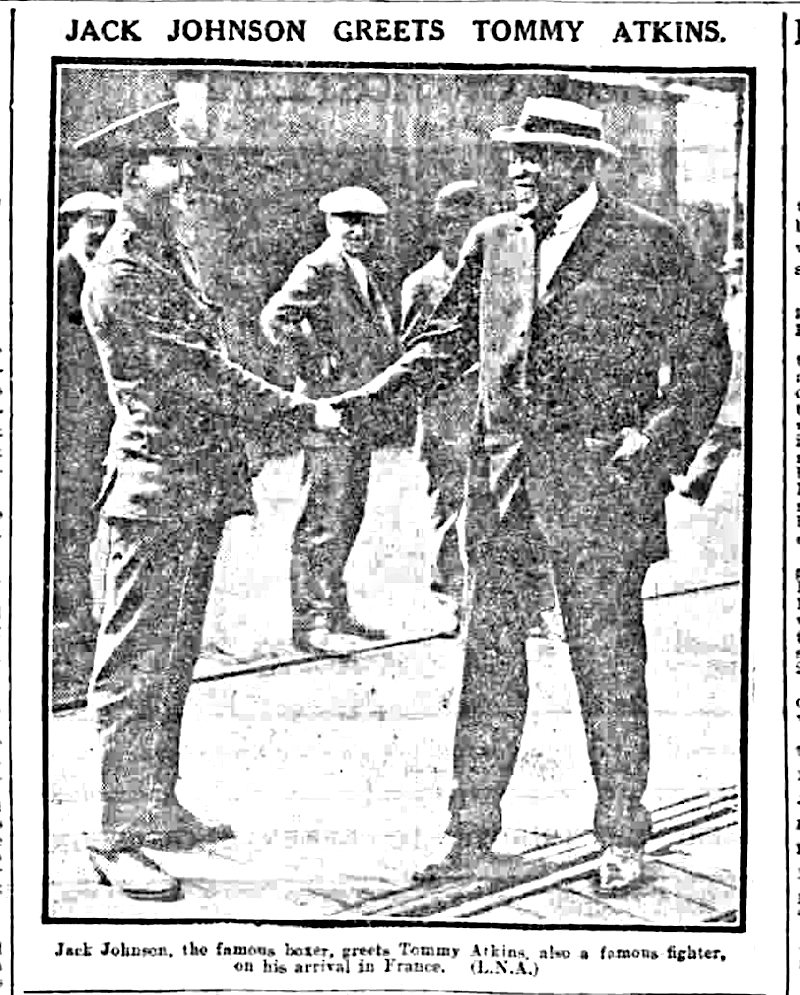
While what would have been the fight of the century never took place, Johnson made a number of further music hall appearances and exhibition fights across the country, drawing both admiration and controversy, both of which would keep his name in the limelight.5 When war broke out, Johnson was living in Paris and was photographed greeting 'Tommy Atkins' in August 1914.
The association of his name with the German shell began in September of the same year, and the troops' use of it as a nickname was popularised in the press by the Official Press Bureau correspondent known as Eye-Witness, whose accounts of the war were widely syndicated.6 Eye-Witness was the pen-name of Major General Sir Ernest Dunlop Swinton DSO (1868-1951), whose name is more commonly associated with the development of the tank, having been assigned the task of official correspondent by Lord Kitchener.7 Moving onto February 1916, and returning to the Wipers Story, the phrase was by then well established and in common use, so the statement 'the basement the press was found, was uncovered by a "Jack Johnson"' makes perfect sense as a German shell hitting a building revealed a basement containing the press, and if you read Captain E. J. Neale's account, it would appear to be a closed case, hence my caution, however...
There are other accounts that mention a 'Private Johnson', which admittedly, given soldier humour, also makes sense in the shell context. In researching most of this exposé, there has been a nagging feeling of 'what if?' What if there was an actual Private Johnson? From various sources, I identified 16 Johnsons who were in the 12th Sherwood Foresters (there are no doubt more):
| Forename | Surname | Service No. |
|---|---|---|
| Allen | Johnson | 14899 |
| Albert | Johnson | unknown |
| Frederick | Johnson | 6023 |
| George | Johnson | 14708 |
| Hardy | Johnson | 16639 |
| Henry | Johnson | 201338 |
| Harry | Johnson | 101490 |
| Issac | Johnson | 19167 |
| John Manifold | Johnson | 16752 |
| Joseph | Johnson | 94246 |
| Robert | Johnson | 94244 |
| Thomas | Johnson | 16595 |
| Williams | Johnson | 20664 |
| William | Johnson | 15853 |
| William | Johnson | 14691 |
| William Henry | Johnson | 21245 |
Going through the names, it was John 'Jack' Manifold Johnson that caught my eye, and although on his attestation form his occupation is listed as window cleaner, on the 1901 census his occupation is given as 'printers compositor'.8 One account of the press's discovery clearly mentions that Johnson had been a compositor in civilian life.9 In terms of my source count, that made it source number one.
The British Newspaper Archive is continually being updated with new titles, and recently several articles from the Buxton Advertiser, dating from around August and September 1964, have come to light. For background, around this time, the BBC was planning to make a documentary on the Wipers Times, spearheaded by producer Chris Rainbow, who put out a national call in the press for accounts and information about the Wipers Times. The planned documentary never went ahead and, frustratingly, it seems that Rainbow collected a fair amount of material which is now missing, but it did generate a few column inches. The conversations that appeared in the Buxton Advertiser were related to this. Notably, it gave the name of Johnson as the compositor of the paper, as well as referring to him as Jack; furthermore, the article included his address (Hollins Street) which ties back to source one. In the following issues, several ex-soldiers wrote in who were friends of Johnson confirming that fact, including George Critchlow (West Road) who served with the Royal Engineers, and Ernest Goodwin (Hardwick Square South). Goodwin mentioned he served alongside Johnson in the Sherwoods, and a search of the records confirm this (soldier number 18291).10 It should be noted that the Buxton Advertiser mistakenly referred to Johnson as the late Johnson until printing an apologia noting he had in fact moved from the area and was living in Hereford.11
So, I had two sources in hand, but given the Jack Johnson slang (and with Jack being a nickname for John) I wanted a third. This came in the form of a newly unearthed account written by Fred Roberts himself which appeared in the Daily Express in 1930 (you can see the entire account here). In this account he clearly names and credits Johnson as the discoverer of the press, as well as noting that Johnson served as the paper's compositor. With three sources to hand, I am more than happy to confirm that John 'Jack' Manifold Johnson was the discoverer of the press — but who was he?
He was born in 1879, to Francis, a joiner, and Mary Ellen Johnson, in the civil parish of Chapel-En-Le-Frifth, Buxton. On the 1901 census, aged 22, his occupation was given as printer's compositor, still living with his parents, as well as two other siblings -- Thomas Johnson (aged 20), also a joiner, and Francis H Johnson (aged 19) an electrician. The address provided was 2 Marlow Street, Fairfield. In 1905, he married Mary Elizabeth Edge (1880-1961) and by the 1911 census, they had moved to Hollins Street and had one daughter named Nancy (born 1906). His occupation on the census was given as a window cleaner.12
He enlisted in the Sherwoods on 13 September 1914 at the age of 34. His attestation form gives his height as 5 ft 6 in., weighing 153 lbs, and describes him as having blue eyes and brown hair. There are several infractions against his name. The first charge was for causing a disturbance in his billet in June 1915, followed by several more serious charges in October 1915, including not complying with an order and using threatening language to a superior. This was just after the battalion had been involved in the Battle of Loos. He received Field Punishment No 2 for a total of 28 days in the autumn of 1915, and one of the punishments was awarded by Roberts, meaning he was no stranger to Johnson when the press was uncovered, and in the above quoted Roberts account, this information adds more weight to Roberts' comment that 'Johnson much preferred printing to crawling around the mud of Hooge'. In addition to discovering the first press, he went out of his way to find the second press.13
Johnson was discharged in February 1919, and returned to window cleaning, working for the Dean Bros Windows Cleaners firm in Buxton.14 His daughter Nancy married George Breterton in 1932 and moved to Saddleworth, Yorkshire. As far as I can determine, they had no children.15 Johnson passed away on 13 June 1966, aged 87 and was buried in Buxton Cemetery.16
As always, if you can provide any further information about Johnson, or the Wipers Times, please do not hesitate to get in contact.
'American Boxing Gossip', Boxing World and Mirror Life, 21 December 1907, p.10. ↩︎
The Johnson-Wells Match: An Appeal from the Pulpit', The Times, 16 September 1911, p.8; 'The Johnson-Wells Match', The Times, 22 September 1911, p.6. ↩︎
'Fight Banned by Mr. Churchill', Daily Express 26 September 1911, p.5. ↩︎
Daily Express, 26 September 1911, p.5. ↩︎
See for example 'Todays News in Pictures', Birmingham Daily Gazette, 26 August 1913, p.6; 'The Johnson Correspondence: Great Mass of Letters', Staffordshire Sentinel, 21 January 1914, p.5. ↩︎
'Reinforcing the British Troops', Sheffield Evening Telegraph, 24 September 1914, p.10; 'Colonel One', Star, 29 September 1914, p.2; 'A Guess at Eye-Witness', Aberdeen Weekly Journal, 15 January 1915, p.8. ↩︎
Ernest D. Swinton, Eyewitness: Being Personal Reminiscences of Certain Phases of the Great War, Including the Genesis of the Tank (Hodder & Stoughton, 1932), pp.39-40. ↩︎
1901 Census England and Wales; TNA/W0363, War Office: Soldiers' Documents, First World War 'Burnt Documents' (Microfilm copies). ↩︎
See the 1930 Nottingham Evening Post entry on Wipers Accounts . ↩︎
'The Wipers Times', Buxton Advertiser, 28 August 1964, p.5'; 'Occasional Notes', Buxton Advertiser, 11 September 1964, p.9; 'How the Wipers Times Came to be', Buxton Advertiser, 18 September 1964, p.9; TNA/W0363, War Office: Soldiers' Documents, First World War 'Burnt Documents' (Microfilm copies). ↩︎
In Retirement', Buxton Advertiser, 2 October 1964, p.4. ↩︎
1881 Census England and Wales; 1901 Census England and Wales; 1911 Census England and Wales. ↩︎
TNA/W0363, 'Burnt Documents'. ↩︎
1921 Census England and Wales. ↩︎
1939 England and Wales Register. ↩︎
Buxton Burial Register, grave 2269. ↩︎
Posts in this series
- The Wipers Times, Tatler, and the Identity of ‘Violet’ from Violet’s Chronicle of Fashion: An Exposé
- The Wipers Times Exposé Addendum: Conclusive Proof, the Letters of Thomas Moore Emmanuel Ward, and Other Contributors Identified
- The Wipers Times Exposé: Staff, Suspects, and Witnesses
- The Wipers Times Exposé: The Printer and the Presses
- The Wipers Times Exposé: The Actor, Avesnes, and the Forgotten Evening Edition of the Wipers Times
- The Wipers Times Exposé: A Picture of Dorothy Violet Hall emerges
- The Wipers Times Exposé: Contemporary Accounts of the Wipers Times
- The Wipers Times Exposé: Jack Johnson, the Private Who Discovered the Press
- The Wipers Times Exposé - A Picture of Ernest James Couzens Emerges