The Wipers Times Exposé: Contemporary Accounts of the Wipers Times
In this section, you can find several contemporary accounts of the story behind the Wipers Times. Originally, some of these accounts appeared as part of the Staff, Suspects, and Witnesses post. As the number of accounts has grown, they have been moved to their own post for the sake of clarity. Note that the Sergeant Tyler Account has been left in situ (for now).
The accounts are presented below in chronological order. For copyright reasons, I have not posted anything here from after 1955.
The most recent addition is an account from Roberts, written in July 1930, in the Daily Express, which has only recently come to light. It is an interesting piece that confirms several details and provides some new leads which are yet to be explored (as of summer 2026). As part of the work I am undertaking for Talbot House, a piece on Fred Roberts is in the pipeline, but there is an important note I would like to add regarding Fred Roberts as a 'witness'.
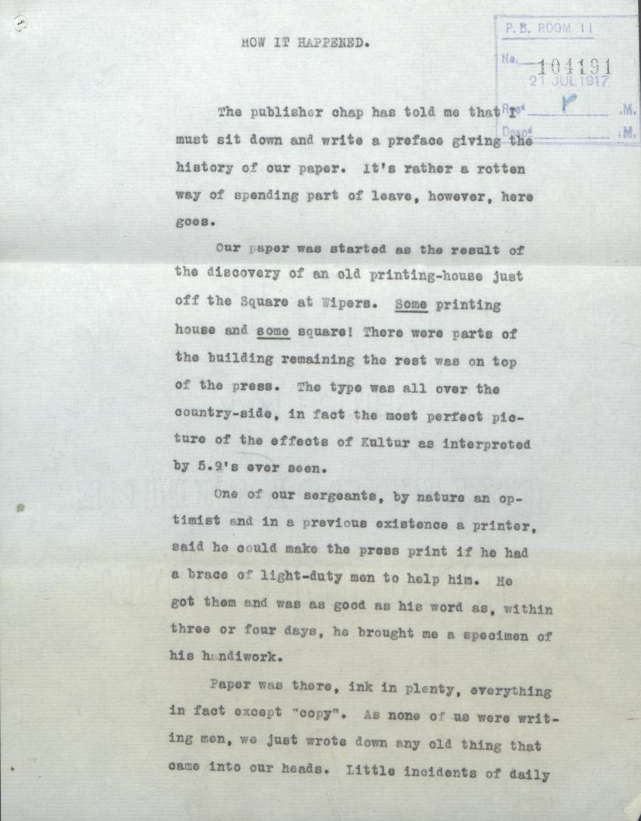
I say this with no malice but from a historian's point of view: he is somewhat unreliable — and it is not entirely his fault. There are three known accounts of the Wipers penned by him. The first account was for the 1917 facsimile versions produced by the publisher Herbert Jenkins with the involvement of the Official Press Bureau, and Mi7a. There is a number of documents still surviving, mainly bureaucratic in nature, between the OPB and Herbert Jenkins which I have seen (on an unrelated note is a letter from Jenkins asking for permission to write to Captain Muller, the captain of the SS Emden, with the intention to produce a book of his experiences; the director of the Press Bureau shut this down as it would be 'trading with the enemy'). Of interest is an early draft of the foreword that would appear in the facsimile version, written by Roberts. It is almost identical to what appeared in print, except for the following:
In the original document, the walls of the casement were described as 15 feet thick. In the published edition, this was changed to 50 feet.
On the initial popularity, the original says, 'Had we only known what was going to happen we'd have printed 500'. In the published version, this was changed to 300.
Added to the published version is the last line: 'The Editor asks those who have so kindly helped him with "copy" to accept his grateful acknowledgment, especially Mr Gilbert Frankau.'
Minor adjustments aside, it is important to highlight that this was written in 1917 with the war ongoing, with the official propaganda apparatus involved . Roberts would have been limited, even directed in what he could and couldn't say. Furthermore, 1917 was an extremely busy year for Roberts: he was married in February and promoted to major and later to lieutenant-colonel of the battalion.
The second account Roberts wrote was entitled 'For Future Historians of the War', which appeared in the second facsimile volume, printed in 1918. Again, it needs to be considered that this was written during war. However, it is a much more detailed account, and now on my god-knows-what-number read through, there is quite a lot of detail hidden (and I believe deliberately) between the sentences which is slowly being unravelled.
The third account, which is below, was published in 1930 some 14 years after the event, and it confirms a few details such as the identity of the printer George Turner , the private who discovered the press, 'Jack Johnson' [insert link], and the name of the school in which the second press was found, Ecole De Bien-Faisance. There are a couple of details that I believe have been mixed up, for no fault other than he was remembering the events of 14 years previously.
One final note about Roberts: I have been privileged to read his unpublished autobiography, and he certainty led a fascinating life, one that would see him interact with figures such as Lloyd George and Winston Churchill as well as undertake some 'under the table work' for the Foreign Office in later years. The truth is, the Wipers story was a small part of his life — in fact he makes no reference to it in his autogbiography. In terms of the First World War, he focused on his friendships with Pearson and others.
Finally, one thing that has struck me from the many accounts of Roberts I have read, was his magnetic personality, and at the heart of this is his skills as an orator — evidenced in the editorials written for the Wipers — but I think it is also fair to highlight that he knew how to add a yarn to a tale.
Contents
1916 Captain E.J. Neale
1916 Major Harry Shirwell
1917 The Ghain Tuffieha Gazette
1918 Review of the Fascimile Version
1921/2 Ypres Times (exact date unknown
1930 Civil and Military Gazette
1930 Nottingham Evening Post
1930 Fred Roberts writing in the Daily Express
1939 James Bayes
(1916) Captain E. J. Neale, writing in the Hastings and Leonards Observer, 25th March 1916, p.7.
Captain E.J Neale, 12th Sherwood Foresters, of St. Leonards, who has been at the front for some months writes:--
"I am sure it will interest your readers and especially yourself to know that it is even possible to publish a newspaper in a ruined place, which was once a beautiful town, and the only living creature left is a cat, which has become quite affectionate; the other living things are Jack Johnsons, Woolly Bears, etc., and the sniper which, of course, makes things more interesting. We live underground and sometimes ramble in the daylight, when not too hot above. In one of these rambles, we came across some type, and collecting it, thought we would start a newspaper. We found the type was short of 'L's; we presume that when the Huns went through the Kaiser took one for himself and distributed the others amongst his attenuated army. However, one day, to help us out of our trouble, he sent over a special messenger in the shape of a Jack Johnson, and a lovely crump moved a cellar and exposed a lot more type and appliances for printing, which we carried to our printing office, a dug out in which we have electric light and at a much less price than they charge at Hastings. Then we proceeded to get "matter," and at the end of ten days brought out first issue out, known as the "Wipers Times and Salient News," 25 francs. We printed 100 copies, none given away, and no returns, we Double the price each week, and never increase the circulation. This issue is published at 200 francs, and we could sell 500 at the price; they go like hot cakes -- and the phone goes all day with 'Will you take 500 francs for a copy;" same result, they are all booked. The British Museum is the only place that gets a free copy. The printers are Sherwood Foresters and Co., Ltd. (The name of the place I will leave.). Every penny goes direct to widows and orphans of our own Battalion.
(1916) Major Harry Shirwell, Guernsey Evening Press and Star, 28 March 1916, p.2.
Major Harry Shirwell, of the 12th (Service) Battalion The Sherwood Foresters (Pioneers), who has just left the Island on his return to the front, brought to Guernsey some interesting war souvenirs in the form of three copies of "The Wipers Times or Salient News.' Numerous periodicals are produced by our gallant men at the front, but "The Wipers Times" is unique, in that it is compiled, edited, printed and published under shell fire. The copies published are dated February 24 and 26, and March 6, and but one more number was to be published, as the producers were about to be sent back for a rest, and could not expect to take their printing machinery with them.
"The Wipers Times" was printed on a machine, and on paper recovered from the ruins of Ypres. The first printing machine was struck by a German shell, and utterly demolished. Fortunately, another machine was unearthed, and the later numbers were proceeded with. Each issue was strictly limited to 100 copies, one each being supplied to Lord Kitchener, Viscount French, General Sir Douglas Haig, General Plumer, Major-General Capper and the British Museum, the remainder being reserved for the officers of the Regiment and Division. Each number comprising eight pages and covers, sparkles with humour from cover to cover---the advertisements included, and the issue is a striking testimonial to the irrepressible Jollity of 'the British soldier, even when engaged in the grim business of war, in a sector which has witnessed more "strafing" than any similar area on the face of the globe.
The humour is such that it can only be appreciated to the full by the men on the spot, but it is nevertheless of a high standard. The contents include burlesques of the writings of Hiliaire Belloc and Horatio Bottomley, but they are eminently good-humoured, and the writers victimised would be the last to complain. A series of articles on the style of Hilaire Belloc demonstrate that there are but 16 Germans left on the western front, and about 150 on the eastern front. There is also a burlesque Sherlock Holmes story, each instalment, we understand, being written by a different author. Burlesque is found even in the price of "The Wipers Times." The price of the first number is given as 20 francs. With the second number the price rose to 100 francs, and with the third to 200 francs. The fourth and last number---the grand double summer number (of exactly the same size), was to be priced at 5 centimes. Other souvenirs brought home by Major Shirwell included fragments of German armour piercing high-explosive shell, and a devotional book printed in Brussels early in the 18th century, and found in the ruins of Ypres. Major Shirwell has been at the front since October 6, and was wounded within a few hours of his arrival there.
(1917) The Ghain Tuffieha Gazette, Ghain Tuffieha Hospital Camp, Malta, 10 February 1917, p.1*
Journalism like everything else is being affected by the War and one phase has been the extraordinarily large number of service Magazines that have been produced.
A writer in the "Spectator" commenting on this fact says "To anybody of men or women with a corporate sense a journal or magazine seems to be as necessary a means of self-expression, as the public dinner".
He goes on to state this this "accidental literature of the War" -- in other words literature due to the accident of temporary congregation -- is nothing very great in the way of literary effort, but that it forms a splendid index as to the spirit in which the war is being conducted.
This is undoubtedly very true and as an instance the circumstances under which "The Wipers Times" was first conceived may be quoted.
The idea of producing this witty little paper coincided with the discovery of a printing plant withing a few years of the new historic Cloth Hall at Ypres. The press was buried under several tons of rubble and debris, but that did not deter the producers, who speedily unearthed it.
The setting up of the type and the printing of the paper was interrupted and frequently dislocated by the inopportune arrival of German shells and we believe it was no uncommon occurrence for part of the type to be broken up and scattered of the four winds of heaven by a sudden strafing from enemy artillery.
However, both Editors and Publishers refused to be intimidated and the paper would then make a belated appearance.
Thus the Wipers Times, which by the way afterwards became "The Somme Times" and is not "The B.E.F. Times" had the distinction of being edited, printed and published in the Firing Line and without any outside assistance.
* This editorial goes on to talk about the Balkan News, which is also of note, as its first editor was an editress -- a Miss Donaldson. There is also evidence to the effect the paper was used for both allied propaganda, and intelligence purposes in Salonika. This, however, is a story for another day. [^9]
(1918) Review of the 1917 Facsimile Version, Boston Guardian, 2 February 1918, p.3.
Only journalists, who know how difficult it is, under the best of conditions, to bring out a journal which shall be satisfactory, not merely to its readers, but -- a much harder task -- to themselves -- can appreciate properly the feat performed by the editor, the sub-editor, and the printer a sergeant, who in former existence, as the editor humorously nuts it, had followed the craft. The first two numbers were produced on a printing press found in a battered building near the square of Ypres, with the editorial room a casemate under the ramparts. Type was short, and only one page could be done at a time not infrequently to the accompaniment of the crash of German shells. After the first two numbers had been printed, a German shell destroyed the "works."
A new press and fresh type were procured: but the paper was never printed out of the front area and once the works were within 700 yards of the front line and above ground, while on one occasion proofs had to be corrected while the editor sat in a trench in the middle of a battle on the Somme.
Yet the staff not only "carried on." But actually ventured to include illustrators by Sapper F. J. Couzens R.E., on a piece of wood with a penknife.
Four numbers of the "Wipers Times"were produced, and then, with changes of locale, came changes of the title. Viz. "The New Church Times" (Four numbers), "The Kemmel Times" (one number), and "The Somme Times (One number).
After this. For reasons not unconnected with the Censorship, the title was changed to the comprehensive one of the "The B.E.F. Times," Which covered the last five numbers. Thus in all, there were fifteen numbers produced between 12th February 1916, and April 10th 1917.
(1921-22) Ypres Times (exact date unknown) *
By an Ex-Field Officer
"'Ere y'are----piper-piper! All the winners! Sensytion! [sic] Full account o' the big fight. Piper!"
The irrepressible young subaltern at the door of the mess beneath the ramparts did it beautifully he did it to the manner born. It was a chill, raw February evening, and everyone seemed dispirited somehow---- we had just heard of the loss of two good fellows in the battalion; but that imitation London newsboy's raucous voice had a sudden magical effect. It relieved the tension; it woke us up to laughter. Everyone, even the " skipper" moved to the door to join in the joke. We saw half-a-dozen grinning faces looking over the subaltern's shoulder. He was actually displaying a newspaper -- only one, alas! -- hot from the press.
It was a miracle -- the thing had actually been printed in Y-pers. Our eyes drank in the title, the advertisements, the "editorial," the poetry, the "stop press news" like thirsty men: and some of us laughed so much that we could hardly stand. Then, as the little sheet was threatened with destruction, so great was our eagerness, a staff-captain, famous for his elocutionary powers, was deputed to read out the entire production after dinner.
More than five years have passed; but the scene is vividly before me as I write. "The Wipers Times" was funny -- funnier to us, perhaps, than it will ever be to anyone who comes after us; but it was not all a jest. There was a strong undercurrent of something else in it. There were things in that first number, as there were in its successors, which struck a deeper note, as "Reflections on being lost in Ypres at 3 a.m.," and many others. But humorous or serious, it was just what we wanted. It seemed to us then, as it seems to me now, a masterpiece amongst "trench journals" -- redolent of the very spirit of the place and of us who dwelt in it.
Could anything be better than that parody of the immortal "Elegy"?
A six-inch tolls the knell of parting day.
The transport cart winds slowly o'er the lea.
A sapper homeward plods his weary way
And leaves the world to Wipers, and to me.
Now fades the glimmering star-shell from the sight
And all the air a solemn stillness holds;
Save where a whizz-bang howls its rapid flight
And " five rounds rapid” Fill the distant folds.
Beneath the ramparts, old and grim and grey
In earthy sap and casement cool and deep;
Each in his canvas cubicle and bay;
The men condemned to Wipers soundly sleep.But there is more than parody in the soldier's recital of the grim realities of war, as he found it in the Salient.
My soldier-soul must steel itself to these;
Must face, by dawn's dim light, by night's dull taper,
Disciplined, dour, gas-helmeted, and stern,
Brigades, battalions, batteries, of paper-
The loud " report," the treacherous "return,"
Division orders, billeting epistles,
Barbed " Zeppelin " wires that baffle G.H.Q.,
And the dread " Summary" whose blurred page bristles
With " facts " no German general ever knew.
Let the Hun hate! We need no beer-roused passions
To keep our sword-blade bright, our powder dry!
*With thanks to Nick Newman for the clipping.
(1930) Civil and Military Gazette, 1 January 1930
THE "WIPERS TIMES" AND ITS CAREER.
London, Dec. 5.
SIX or seven weeks ago, in writing of the impending death of the Cologne Post, I was led to refer to "soldiers' papers" generally and to the Wipers Times in particular; and thereby I seem to have excited an amount of curiosity which suggests that the little journal of the trenches is less known than I had supposed. • That being the case, perhaps no apology is needed for dealing with it again, this time in greater detail, for the Wipers Times was a thing to be taken at much more than its face value. It came into being almost by accident, no doubt; but the accident may almost be considered a providential one, for the time---the early part of 1916---was one of intense gloom and depression, when discomfort was at its worst and anything that tended to bring a little action into the trenches was a godsend.
Adventurous Existence.
Its adventurous existence lasted just a couple of years. And, though Its circulation was, necessarily, small, every copy that it produced passed through hundreds of hands. It was by no means official. No battalion, even, could be held responsible for it, though its imprint" Printed and published by Sherwood, Forester and Co., Ltd."--- conveyed a hint as to where the moving spirit, or spirits, might be found. But the way in which it made perpetual fun of the horrors of the Western Front and "kept smiling" when the task was anything but an easy one mad e its value incalculable.
Its editor, from, first to last, was one F. J. Roberts; its sub-editor J. H. Pearson; and when, on one or two occasions it had illustrations, they were from blocks "carved on a piece of wood with a penknife" by a sapper, T. J. Couzens. Contributions came to it from all quarters many of them from Gilbert Frankau when his anti-aircraft battery did not keep him too much occupied. It was, at times, rather overloaded with verse. But this, its parodies of the war-correspondents and military critics of the day, its stories, its answers to imaginary correspondents, its fashion column, its "letters to the editor," and its spoof advertisements were all of them full of irresponsible fun...
...Now and again some occasion demanded a serious paragraph; but even this was made a means of chaffing the censorship---- It was easy enough, of course, to do it in such a way that nobody on the spot would have any difficulty in filling the blanks...
...The first "office" of the paper was in a casemate under the ramparts of Ypres, in which a mechanically minded sergeant had put into working order the press found in a small printing establishment wrecked by shell-fire. The office contained not only the press, but a gramophone and a piano. Four numbers were produced at Ypres, but then the "staff" was ordered to the Somme, and, of course, the paper had to go to---as its editor, said with justifiable pride, more than a year later: "The paper has never yet been printed out of the front area, and once our works were within 700 yards of the front lie, and above ground." A Shell found its way into the office after the second number had appeared, and this was considered fortunate, as it provoked the staff to raid a printer's place near Hell-Fire Corner and find some much-improved plant.
There was an impish sense of fun which led to the change of title to the New Church Times when a move had to be made to Neuve Eglise. Each move, of course, presented awkward problems of transport, as the press and the type had to go wherever the "office" went; but it was always found possible to "win" a lorry for the purpose by some means or other. In Loos, the editor said, "the rats did not mind us sharing their habitation," and there "the paper had a long and successful run in spite of the fact that the whole of the outfit nearly got blown off the map on two occasions." At Arras they had "quite an enjoyable time," as it was "not a bad war." But at last a heavy bombardment smashed up office, press, and type, and made further publication quite impossible, and so the Wipers Times, which by this time had become the B.E.F. Times---the censor had grown particular, and would have no place-names mentioned---came to an end after publishing twenty-one numbers under the most extraordinary difficulties that any newspaper staff ever experienced.
Original Copies.
Copies of the original publication were few to begin with, and difficult to preserve, so that they have now become very rare. It is seldom that one changes hands; and if ever a purchase is made it is at a price which would buy a considerable library of serious war books. But, fortunately, the complete series has been reproduced in facsimile. Herbert Jenkins, the London publisher, issued one volume after the fifteenth number had appeared, and charged six shillings for it. The second volume came, at seven-and six, when the little paper had been blown to bits by the enemy. And the two together make a "souvenir" without which no collection of war relics is complete.
(1930) Nottingham Evening Post, 15 July 1930, p.8.
"THE WIPERS TIMES."
HUMOROUS MIRROR OF LIFE THE TRENCHES.
War Journals return.
If war had achieved nothing else, would deserve to be remembered as the reason for two distinct acts comic genius of the kind that only the British "Tommy" could produce, with a smile which was perilously near tears, and yet endowed with singular and disinterested courage. These two acts of genius were the cartoons of Bruce Bairnsfather which caught in an uncanny way "the spirit of the troops", and, what must have been far more difficult to sustain, the Wipers Times." The Wipers Times," with which incorporated ---quite in the style of some forms of modern journalism --- "The New Church Times." The B.E.F. Times" (for " reasons not unconnected with the censor." as the editor explains), and Better Times." has now been published by Messrs. Eveleigh Nash and Grayson and edited by the original editor, Lieutenant- Colonel F. J. Roberts. It gives much better idea of what the British soldier's life actually was than some recent books.
The "Wipers Times" was born as the result of a piece of ''scrounging" by Private Johnson, who had been compositor private life. It had many vicissitudes.
SHERWOOD, FORESTER & CO.
Under whatever title, it was at all times the complete journal. There the solemn editorial, entering with each issue a dignified protest again the machinations of our local rival, Messrs. Hun and co.," whose jealousy so frequently prevents the paper from appearing on the proper date. There are sporting notes, City news, a "Gossip" column, letters from correspondents who claim to have heard the cuckoo on the Menin-road, and even news of property market Wo regret to report further rise in property to-day "). Nor is the imprint forgotten, and each issue proclaims its back page that it is printed and published by "Sherwood, Forester, and Co., Ltd., Ypres and Hooge."
Besides all these features there are "strong" articles from publicists, messages from very special correspondents every front, a mammoth competition with millions of francs prizes (eventually won the editor and sub-editor), and floods of verse; indeed the editor has to make special appeal to his contributors to write more prose---whereupon Mr Gilbert Frankau, a pillar of the journal throughout its life, responds with I more verse, but prose form.
THE ADVERTISEMENTS.
The advertisements inspired the same fertile wit and humour are often even better than the editorial contributions. Wherever the paper goes, the music-hall and cinema advertisements follow it. The "Wipers Times" announces the attraction of the Cloth Hall ("the best ventilated hall in the town"). The "Better Times" bills Professor Foch and his Performing Dove, and a special turn Signor Potentiario.
Indeed, there is scarcely any commodity that is not advertised this magazine. Under Building Land for Sale" appears the following exhortation:
Build that house on Hill 60. Bright, breezy, and invigoration. Commands an' excellent view of the historic town of Ypres.
The "Agony" columns are full of heartrending appeals. In the first issue "Lonely Soldier" asks: Will any patriotic person please lend a yacht and £10,000 to a lover of peace '! Size of yacht immaterial.
Disappointed, apparently, the same advertiser offers in a following number: For Exchange.---A Salient in good condition. Will exchange for a Pair of Pigeons or Canary. Lonely Soldier. Hooge.
Lieutenant-Colonel Fred Roberts M.C., Daily Express, 25 July 1930, p.9.
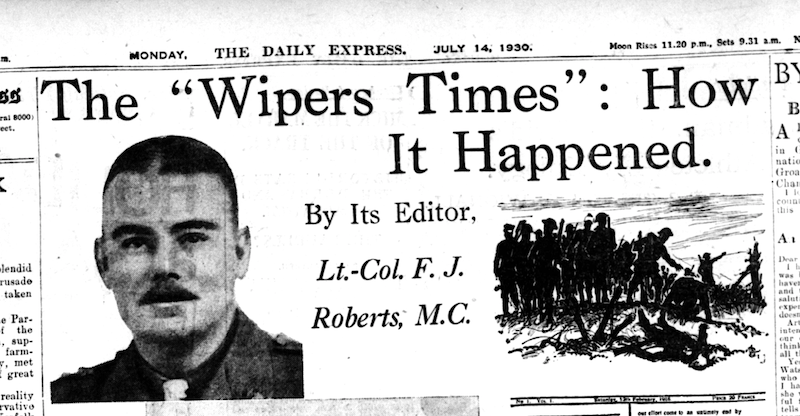
The "Wipers Times": How It Happened. By Its Editor, Lt-Col. F.J. Roberts, M.C.
The "Wipers Times" owed its origin to the scrounging instincts of a
private of a pioneer battalion, who, as most of the gas meters had by
this time (January 16) been cleared, was fossicking in side streets for
anything that might be of use or interest.Entering a house which had evidently been the object of some attention
from the Hun, he saw that if had been a printing works, probably the
headquarters of the local Daily Express, or whatever they had there.
He happened to have been in pre-war days a compositor on, I think, the
"Nottingham Guardian," by name Johnson.He mentioned the matter to Sergeant Turner, who also was a printer by
trade, having served many years on the "Manchester Guardian."At this time I was in command of three companies of the 12th Batt.
Sherwood Foresters, with headquarters in the ramparts at Ypres, and the
sergeant brought me the news of the discovery, with a statement that he
could make the press work.I went round to look at it, and found that, although shells had
damaged the outfit fore and aft, the centre, or printing piece, was
more or less intact. Also, the room was covered to a depth of about
an inch with type of every kind, although there was a shortage of
large "E's." There was a good lot of paper, and a drum of printing
ink.***
I gave them permission to go ahead and get the whole outfit into
working order.Their announcement that the press would work coincided with orders to
stand up in support for the retaking of a disputed piece of country
called The Bluff. As an experiment we ran out a single-leaf paper,
giving all the lates details "about the big fight." Only about twenty of
these leaflets were printed, and, unfortunately, all trace of them has
been lost, but the idea was such a success that there was only one
course open to us ---- we must run a magazine.I immediately made preparations for the issue of a paper, and sent round
word that copy of any kind would be acceptable. One of the first to
respond to the call was Captain Gilbert Frankau, who was then a
perspiring gunner adjutant, who, owing to the lack of shells, was out of
work. (It may be remembered that in those days the shell issue was one
per gun per year, or thereabouts.)***
Our first number was a howling success, and support was forthcoming from
the higher command. Major-General Bertram Mitford was one of our most
enthusiastic readers. Major-General Sir John Capper, too, was good
enough to give us much encouragement. Field-Marshal Haig and
Field-Marshal Plumer were regular subscribers, and it may be said here
that the proceeds were of no little benefit to the padre's charities.The first two numbers were successfully issued before the enemy
committed an unfriendly act by dropping a 5.9 in the middle of the
works. Private Johnson, who for some reason preferred printing to
crawling about in the mud of Hooge, immediately unearthed a smaller and
much more useful press as the Ecole De Bien-Faisance, some distance up
the Menin Road.Although the enemy was particularly unfriendly at the moment, by the
help of a barrow the two men managed to get the press into Ypres, where
it was installed in the ramparts.We became inundated with copy from all ranks. Generals vied with
privates in wishing to give their opinion of the war, Hooge, the Staff,
Ypres, the Hun, and a thousand other things.In those days we did not look far ahead, otherwise the contents of the
waste-paper basket would have been carefully kept. As it would have
needed a special battalion provided with some special gas helmet to
expurgate most of the copy, we reluctantly had to turn it down.Two more numbers were brought out before we were shifted to a new area.
By this time we had received the blessing of G.H.Q., and a lorry was
placed at the disposal of the press whenever removal was imminent.***
The fifth number, "The New Church Times," was printed at Neuve Eglise,
in a building adjacent to a laundry, in which some thousands of Belgian
females of all sizes and ages carried on their cleansing operations.This was a remarkably peaceful area in those days, and shelling was very
rare. But on one occasion the Hun registered a direct hit in the middle
of the blanchisserie, and a slow-motion picture of the departure of the
occupants would have been a certain draw.We only had two weeks in this haven before moving on to Kemmel, where
one number was produced. Then we got orders to move again.By this time there was a very unseemly disturbance going on the Somme in
which we became involved. The first number of the "Somme Times" was
printed just by Fricourt. Proofs of this number were corrected by
Gilbert Frankau and myself in a trench by Mantoban [sic].This was the last number which we printed in the name of the sector
in which we happened to be at the time, as we were notified by GHQ
that the enemy might get information of our whereabouts and do
something hasty. So all future numbers were called the "BEF Times"
-- with the exception of the last two, which were called "Better
Times."The press which we were now using was in operation up to the time of the
German attack of March 21, 1918, when, together with other incidentals,
the enemy took possession. It was not until our turn came, in September,
that we were able to "scrounge" another press.This we did at Avesnes, where we discovered, besides the press, all
sorts of beautiful little blocks, so that you will see the two final
numbers embellished with illustrations.Of course, each block meant that some article had to be written so that
we could use it, and the picture of Olga preparing to retire for the
night was our special joy.The meaning of some of the advertisements and articles may be a little
obscure, but everyone had a bearing on some particular incident which
happened at that time. The "Wipers Times" is, in fact, a record of a
great deal that would otherwise have gone unrecorded. If only in this
respect, I think it can be said to be absolutely unique.
(1939) James Bayes writing in the Portsmouth Evening News, 13 February 1939, p.8.
THE "WIPERS TIMES ANNIVERSARY OF A UNIQUE JOURNAL"
By JAMES BAYES
TWENTY-THREE years ago yesterday there appeared the first number of a publication unique in the history of British journalism. It boasted ten crudely-printed pages, one of which bore an advertisement exhorting readers to Build That House On Hill 60 ---Bright, Breezy---invigorating." The journal was priced at 20 francs, and its name was The Wipers Times.
In the early days of 1916 a few British officers and a sergeant, investigating the ruins of a building just off the square in Ypres, unearthed battered printing-press from the debris. They found ink and paper, too. The smell of the former seems to have had a nostalgic effect on the sergeant, who was a printer in civil life, for he announced that with the aid of a light fatigue party he could put the press in working order. The type had been distributed far and wide, as only a 5.9 can distribute type, but by dint of long and painful scouting a fount (of sublimely archaic pattern) was gathered together, and on February 12, 1916, No. 1, Vol. 1 of the Wipers Times was being handed round in the front line. In the opening editorial the journal apologized for delay in going to press owing to "many unwelcome visitors outside our printing works," and expressed condolence with those of its readers who had been mugs enough to pay 20 francs for their copy. The front page bore the advertisement:
WIPERS, FISH-HOOK, AND MENIN RAILWAY Daily Excursion Tickets issued to MENIN (Until further notice trains will not go beyond Gordon Farm Station. Line beyond closed for repairs)
Under Fire
The early numbers of the Wipers Times were produced in a casemate in the old ramparts. The first two issues were published under heavy shell-fire, but this had little effect on the hilarious tone of a journal which was destined to live for two years. One of the great difficulties in early days of the paper was that one page only could be printed at a time, and the publishers had no y's or e's "to spare when one page was in the chaser." Accordingly, when a page was put up, the sergeant and his devils would go to the door of the casemate and weigh up the atmosphere. If all was moderately quiet they would make a dash for the press, which was up by the Cloth Hall, and there they would stay turning out copies till shells fell too near to be pleasant. In due course the paper was able actually to print illustrations. These took the form of line drawings, which were patiently hacked out on pieces of wood by a sapper whose only tool was a penknife.
Every copy of the journal bore a price, printed below the title-head. Actually, this was fictitious price, as it was intended from the start to distribute the paper free. But, as the opening editorial revealed, there were ardent readers who took the prices seriously, and "weighed in." The publishers found this a useful fact to bear in mind when the demand for the paper became too intense. The greater the circulation, the higher became the price." This plan worked quite well for a time, but gradually the demand increased, and ultimately, after having raised the price to 200 francs, and with the circulation still climbing, the publisher brought the price down with a bump to 50 centimes and gave up the endeavour to cope with the demand.
The "Wipers Times" was yet in its infancy when the Germans scored a direct hit on the works ---happily not on a press day. As it happened, this proved a blessing in disguise, as the publishers were quickly put on to most convenient hand-jigger and some more type somewhere up by Hell-fire Corner. More and more fertile brains were assisting the paper to extract the maximum of humour from the War. The Answers to Correspondents and the Agony columns were the most popular ("Dearest ---I waited two hours on the Menin Road last night, but you didn't come. Can it be a puncture that delayed you? Write c/o this paper.").
Inferno
Turning over the bound facsimile copies which I picked up years ago at an auction, I see that according to the advertisements," the Menin Gate Cinema was showing the great spectacular picture Inferno and that' 50 000 artistes have been engaged to produce this colossal work, at enormous expense. Music and effects of this great picture by the International Orchestra." Other advertisers offer to insure dug-outs "in dangerous positions," to cure optimists who believe the War may end in twelve months, and to sell stock in the Wipers and District Gas Company." Many attractively, worded advertisements for charabanc excursions are to be found, the delights of Plug Street Wood, Messines, and Commines being especially recommended.
Letters to the Editor are numerous and varied. One correspondent complains that a part of the roadway in Ypres is still up, "and to my knowledge has been in this state of repair for at least six months." Another protests against the wanton damage which is being done to the fields of farmers around Ypres. And there are, of course, not a few letters from indignant householders calling upon the city fathers to put a stop at once to the "night noises," apparently caused by a band of hooligans," which repeatedly disturb their slumbers.
The paper bore a different title, according to the district in which it was printed. Thus, in the course of its existence it was known successively as the Wipers Times, New Church Times, Kemmel Times, Somme Times, and finally---for reasons of censorship the B.E.F. Times. Some of the proofs of the Somme Times were actually corrected in a front-line trench while the editorial staff were awaiting zero hour to go over the top.
The End
The transporting from place to place of the press, which weighed three tons, was in itself no mean feat, particularly as it had be done unbeknown to the "red-caps."
The end came in March, 1918. In the course of a terrific bombardment another 5.9 landed on the (Untenanted) "Office" of the paper, and once again the type was distributed as only a 5.9 can distribute type. But the press was distributed, to, complete with the fourth instalment of "Our Grand New Serial, 'Zero,"
So died the "B.E.F. Times," and with it perhaps the most gallant journalistic effort of all time.
Some of the "Copy" for the number in course of publication fell into the hands of the enemy. It is said that German officers spent quite a time puzzling over the mysterious documents before realising that what they were up against was not a new sort of code system, but something far more formidable -- an example of the British Sense of humour.
Posts in this series
- The Wipers Times, Tatler, and the Identity of ‘Violet’ from Violet’s Chronicle of Fashion: An Exposé
- The Wipers Times Exposé Addendum: Conclusive Proof, the Letters of Thomas Moore Emmanuel Ward, and Other Contributors Identified
- The Wipers Times Exposé: Staff, Suspects, and Witnesses
- The Wipers Times Exposé: The Printer and the Presses
- The Wipers Times Exposé: The Actor, Avesnes, and the Forgotten Evening Edition of the Wipers Times
- The Wipers Times Exposé: A Picture of Dorothy Violet Hall emerges
- The Wipers Times Exposé: Contemporary Accounts of the Wipers Times
- The Wipers Times Exposé: Jack Johnson, the Private Who Discovered the Press
- The Wipers Times Exposé - A Picture of Ernest James Couzens Emerges